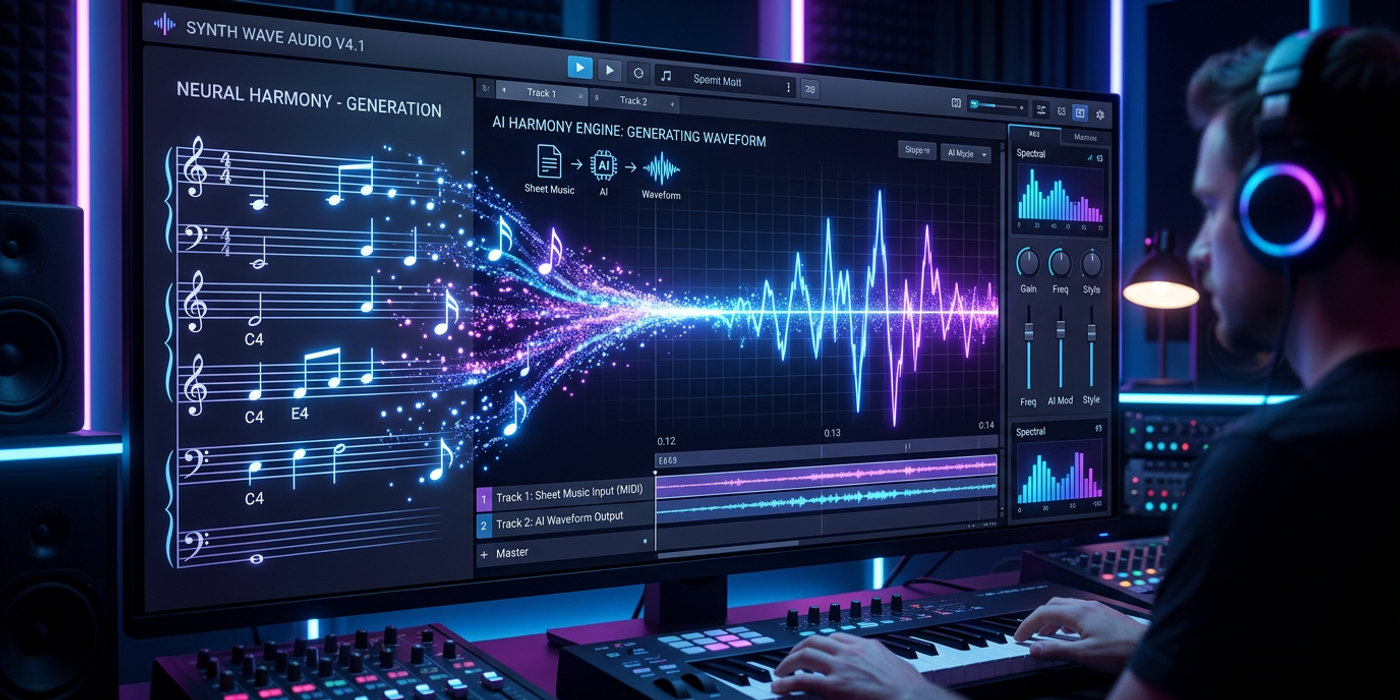
MiniMax-Music3 generates full five-minute songs from lyrics and a music description. Open weights, commercial use, and ready for HK creators.
MiniMax released MiniMax-Music3, an open-weights text-to-music model that generates complete songs from lyrics and a structured music description. Unlike most AI music tools that output short clips or instrumental loops, Music3 produces a full five-minute track — vocals, instrumentation, arrangement — in a single generation pass. Here's what Hong Kong creators need to know about this launch.
What MiniMax-Music3 Does Differently
Most text-to-music models take a single prompt like "upbeat electronic track" and return a 30-second loop. Music3 takes two separate inputs: lyrics with section markers (verse, chorus, bridge) and a detailed music description covering genre, tempo, instrumentation, and mood. The output is a complete song with structure — verses lead into choruses, bridges break up the repetition, and the arrangement has a beginning, middle, and end.
The audio quality is production-ready: 32 kHz, 16-bit stereo WAV, which matches professional audio standards. That means no upscaling or post-processing step is required before using the output in a video, ad, or social media post.
Open Weights and Deployable on Day One
This isn't a research preview or a waitlist launch. MiniMax published model weights, inference code, and three documented deployment paths on release day. The architecture pairs a Hybrid-LM — an 8B Global LLM with a 0.6B Local LLM — with a continuous synthesis stack built on flow matching and a Flow-VAE. The model can run on a single consumer GPU, making it practical for agencies and studios to self-host.
The training tokenizer uses eight layers of residual vector quantization. The first semantic codebook carries core musical structure, while seven acoustic codebooks encode residual detail. This hierarchical approach preserves long-range song structure while maintaining high audio fidelity — the same technique used in professional audio codecs.
Commercial Licensing for Creators
The MiniMax-Music3 Community License permits commercial use with two conditions: you must display "MiniMax-Music3" prominently in any product UI that uses the model, and organisations with over US$20 million in annual revenue from Music3-powered products need separate written authorisation from MiniMax. For Hong Kong's typical creative agencies, studios, and freelance creators, this threshold is comfortably above reach.
What This Means for Hong Kong Creators
Hong Kong's advertising and content production scene runs on music. Background scoring for TV and social media ads, sonic branding for retail campaigns, demo tracks for jingles, and mood-based playlists for branded content — these are daily needs for agencies serving clients like HSBC, HKTB, and Lee Kum Kee.
MiniMax-Music3 opens up a new workflow: write your lyrics and describe the sound you want, and get a custom track back in minutes. No licensing fees, no stock music subscriptions, no back-and-forth with composers for scratch tracks. For rapid prototyping in pitch decks and concept videos, this is a significant time saver.
On Cooly Studio, we're watching this space closely. AI music generation is the next frontier for all-in-one creative toolkits, and Music3's open-weights approach makes it a strong candidate for integration alongside existing image and video generation tools.
Frequently Asked Questions
Q: Can MiniMax-Music3 generate Cantonese lyrics? A: The model accepts text-based lyrics in any language. Cantonese lyrics with proper section markers should work, though vocal synthesis quality depends on tonal language coverage in training data.
Q: How long does a single generation take? A: On a consumer GPU, generating a five-minute song typically takes 2-4 minutes. The output is delivered as a single 32 kHz stereo WAV file.
Q: Do I need technical skills to use it? A: Some familiarity with running AI models is helpful. MiniMax provides three documented serving paths, so users comfortable with command-line tools can get started quickly.
Q: Can I use the music in commercial projects? A: Yes, the community license covers commercial use. Display "MiniMax-Music3" in your product UI and respect the US$20 million revenue threshold.
Q: How does this compare to Suno or Udio? A: Music3 is open-weights and self-hostable, unlike Suno and Udio which are API-only. For agencies generating high volumes of custom music, self-hosting can be more cost-effective.